20 Great Reasons For Deciding On Floor Installation
Wiki Article
How Much Is Floor Installation In Philadelphia?
In the city of Philadelphia, flooring prices Philadelphia are among those topics where you'll find wildly various numbers based on where you look. In addition, much of the data available online is generally national average data that doesn't accurately reflect local labor rate or is not precise enough to be helpful for those trying to prepare a budget for a job. The Philadelphia metropolitan area has its own pricing dynamics: union-adjacent labor markets, an elderly housing stock which often presents subfloor issues, and a wide swath of budget installers and licensed flooring contractors who carry proper insurance. Here's a nitty-gritty breakdown of the actual cost for installation across the city and surrounding counties today.
1. LVP Installation Is Your Most Affordable Starting Point
Luxury vinyl planks are consistently the most affordable option for installation in Philadelphia. The majority of LVP flooring providers have their prices from $2.50 up to $4.50 per square foot if labor is included The mid-range LVP material adding another $2 to $5 in square feet. All-in, a typical room runs $4.50 to $9 for each square foot installed. It's easy to install, requires minimal subfloor prep in many cases, and the floating method reduces labor time by a significant amount when compared to nail-down glue-down options.
2. Hardwood Installation Costs Moreand for a reason!
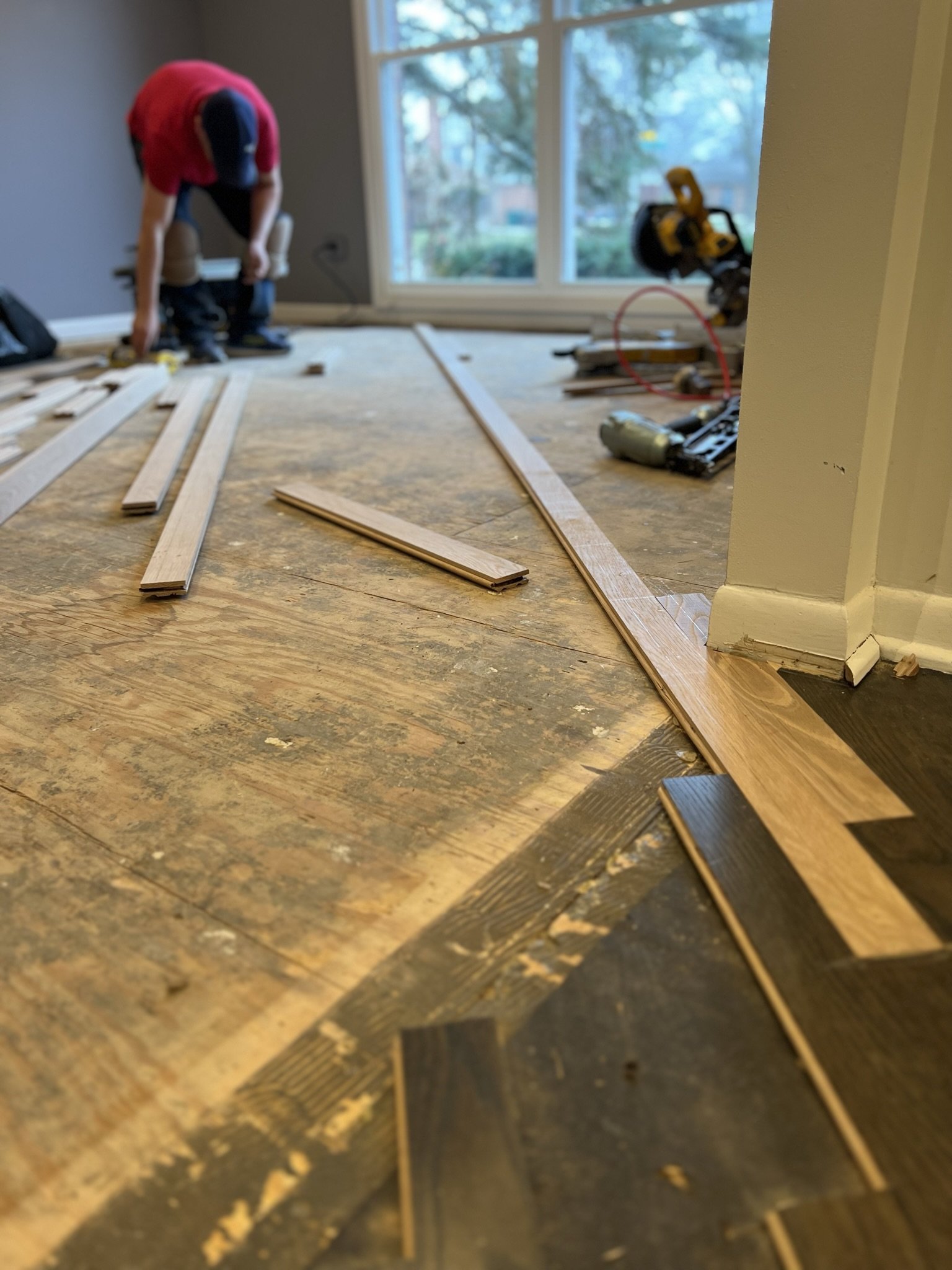
Solid hardwood flooring in Philadelphia generally ranges from $6 to 12 cents per square feet of labor, based on the technique used for installation or the professional. Nail-down hardwood can be considered to be at higher cost because it requires greater exactness, a precise depth for the subfloor as well as longer time for installation. A glue-down wood slab will cost more material for adhesive. The wood itself can be very different and budget hardwood begins at $3.50 per square foot and the highest quality species like white oak or hickory will be anywhere from $10 to $13 per square foot prior to the nail is inserted.
3. Hardwood Refinishing is Less Expensive than Replacement - Usually
If your floors are structurally sound floors, floor sanding or refinishing in Philadelphia typically costs $3 to 6 dollars per sq ft -much less than ripping away and replacing. Refinishing with custom hardwood staining adds cost but is still cheaper than installing new. The caveat is that floors which are refinished multiple times and have extensive water damage or aren't strong enough to pass another time aren't necessarily feasible candidates. A proper assessment from a flooring professional who is licensed will indicate which side that line you're on.
4. Tile Installation Carries a Higher Labor Premium
Ceramic tile and porcelain installation is the most labor-intensive flooring type. Philadelphia flooring firms typically charge $7 to $14 per square foot for labor to install tile with porcelain being at an upper end due the difficulty of cutting. Big-format tiles with diagonal design, and bathroom tile installations that have borders or niches can push costs further. The costs for the tiles range between $1.50 in square feet of basic ceramic to $15-plus for premium porcelain. If you've heard of an unfavorably low tile cost and you're not sure what's included, ask for specifics.
5. Laminate Installation In Between LVP and Hardwood
Laminate flooring in Philadelphia typically costs between $3 to $6 per square foot when installed as materials, which are included at cost end. The flooring is floating, just like LVP also, and thus labor costs are comparable, however, laminate is less tolerant of subfloors with uneven surfaces and is more susceptible to moisture. This determines where it's able to be placed in a Philadelphia home. Cost-effective flooring installation quotes usually involve laminate, and it's not always the wrong call in the context of the space.
6. Subfloor Repair is a wildcard which catches homeowners off guard
This is the line item that blows budgets the majority of the time. Subfloor repairs in Philadelphia including patching cracks, leveling and resurfacing sections of old subfloor can cost from approximately $1 to $3 per square feet on top of your flooring costs, often more. Older homes in Kensington, Germantown, West Philly and similar areas are especially susceptible to this. Any flooring estimate that doesn't include a subfloor analysis prior to quoting you a final number should be treated with caution.
7. Your Location within the Metro Influences Your Quote
Flooring installation costs and costs for installation of flooring Bucks County, Montgomery County, Delaware County, and South Jersey aren't dramatically different from Philadelphia as a whole, however there are differences. Suburban contractors are often less expensive in cost of operations; city jobs may require access or parking. When you're reviewing quotes for multiple counties, be sure you're comparing like-for-like on what's included -- materials including subfloor prep furniture moving, haul-away are dealt with differently by different contractors.
8. Getting Multiple Free Flooring Estimates Is Non-Negotiable
Many reputable flooring professionals in Philadelphia offer free estimates. It is recommended to request at minimum three estimates before committing to anything. The distance between the lowest to the highest quote for the same job usually ranges between 30-40 percent, and the cheapest price is not always the most effective however, nor is price the most expensive necessarily the most effective. What you're looking at is whether the contractor actually evaluated your subfloor, interpreted the requirements, and priced appropriately.
9. Engineered Hardwood Can Serve as a Middle Price Point
Engineered hardwood installation in Philadelphia generally costs between $5 and $9 per square foot installed less than solid hardwood, more than LVP, and has high-performance characteristics that make it the right choice in lot of situations. It's worth asking the flooring contractors you work with to include the option of engineered wood in the estimate they provide if you're stuck between solid wood and vinyl plank.
10. The Lowest Price Often Do Not Survive Contact with the Actual Job
Experienced Philadelphia homeowners can reveal that this is true from experience. A quote that appears to be lower than the market typically means that something is not included -- subfloor work as well as transitions, basesboards or proper material acclimation. Certified flooring installers incorporate these things into their estimates as they know that the work requires them. Unlicensed budget operators let them go to win the bid, but then they present their add-ons later once the installation has begun. You must have all items listed in writing prior to any person begins pulling the floor. Read the most popular
laminate flooring installation Philadelphia for site recommendations including hardwood flooring Philadelphia, hardwood floor refinishing cost Philadelphia, hardwood floor installation cost Philadelphia, kitchen tile flooring Philadelphia, licensed flooring installers Philadelphia, floor installation Delaware County PA, hardwood floor installation cost Philadelphia, hardwood floor resurfacing Philadelphia, laminate flooring installation Philadelphia PA, flooring installers Philadelphia and more.
Waterproof Flooring Options For Philadelphia Bathrooms
The bathroom is where flooring decisions offer the smallest margin of error. In every other room of the Philadelphia house can tolerate an item that's only water-resistant while a bathroom will not. The steam of showers, the water around the bases of toilets, splash zones at sinks and the general humidity that an enclosed bathroom produces daily will reveal every flaw in flooring that's not really waterproof. Philadelphia houses have additional problems old subfloors that could already be carrying moisture as well as bathrooms that were not upgraded since the 1970s and in many rowhomes bathrooms stacked above finished living spaces in which a flooring failure means problems with ceilings downstairs. This is what works, what doesn't and the questions to ask before putting any bathroom flooring in.
1. Porcelain Tiles are the Benchmark The Rest of the Tiles Get Compared
There's a reason porcelain tile has been the most popular bathroom flooring choice for decades It is inert to water at the tile's surface. It also withstands moisture and steam without degrading in any way, and when installed properly and grout sealing it will outlast all other options in a wet environment. Porcelain tile installation for Philadelphia bathrooms is a preferred choice that has the longest-running record. The negatives are obvious -cold underfoot, hard joint joints, frequent grout maintenance required -- but there's no other product that matches its combination of waterproofing performance and durability when used in bathrooms.
2. Ceramic Tile Is a Legitimate Step Down, but not an equivalent alternative
It is true that porcelain and clay are frequently used interchangeably, but they're not the same thing in the context of bathroom. There is more permeability in ceramic than with porcelain, which is important for a room where moisture is constant, not periodic. for a powder room or a guest bathroom with low use, ceramic tile flooring is a reasonable and affordable option. In a bathroom used as a primary in an Philadelphia home that is subject to daily showering, the strength and resistance to moisture is well worth the extra cost per square foot. The procedure for installing is similar -- the performance over time isn't.
3. LVP Is the Most Practical alternative to tile that is waterproof.
The luxury vinyl plank has made its mark in the conversation about bathroom flooring. The plank itself is 100% waterproof. The core does not absorb water, the surfaces don't decay with exposure to moisture, and it's warmer and more comfortable underfoot than tile. One of the caveats to install in bathrooms is that the waterproofing of LVP applies on the planks and but not always to seams between them. A bathroom that has a significant water exposure, such as a walk-in shower with no barrier, or a freestanding tub -- water can work into planks or eventually reach the subfloor. Proper installation technique and seam sealant is required here more than in any other room.
4. Laminate Flooring in Bathrooms is a Decision You Will Regret
This must be stated clearly, as laminate is still showing in bathroom flooring estimates, usually on the strength of its lower price point. Laminate has a wood fiber core. The continuous bathroom and the wood fiber moisture are incompatible. The edges expand, the seams lift, the surface layer separates, and the damage accelerates in a bathroom faster than in any other room of the house. Installing cheap flooring laminate in a Philadelphia bathroom isn't an inexpensive option. It's an expense that will be delayed by several years. Anyone who suggests laminate for a bathroom that is not a main one should be confronted directly on the reasons.
5. The subfloor beneath a Philadelphia Bathroom has to be assessed honestly
Older Philadelphia rowhomes and suburban colonials generally have bathrooms with subfloors that have evidence of moisture history. This could be from previous leak stainings, soft spots resulting from decades of exposure to water or old board subfloors with a higher amount of water than they are required to absorb over time. The installation of new flooring made of waterproof over an existing subfloor won't fix the underlying problem, it covers it while it continues to get worse. The repair of subfloors in Philadelphia bathrooms before the new flooring is put in place isn't an opportunity to make a sale, it's necessary for the new flooring to work properly and not be ruined prematurely.
6. Floor Heating Compatibility varies by Material
Heating floors for bathrooms- now used in Montgomery County and Delaware County home improvements -- isn't compatible with every flooring. Porcelain tile is able to conduct and hold heat well, making it the ideal surface over an heated subfloor. LVP is incompatible with radiant heating however there are temperature thresholds which need respect -- excessive heat may cause the dimensional instability. If bathroom floor heating is part of your renovation, the flooring material decision and the heating system's design need be discussed with one another, not in isolation.
7. Bathroom Tile Layout Impacts Both appearance and water management
This is one of the things that is what separates knowledgeable tile flooring installers from those with no experience in how to put tiles. Bathroom floors require a slight slope towards drain, typically 1/4 inch per square foot- to prevent standing water. Tile design that does not account the slope, or fights against it with large-format tiles that cross the slope, will cause pooling problems that eventually work into the subfloor. The layout conversation with your contractor should also include how the tile pattern interacts in relation to the location of the drain, and not only what it looks like on paper.
8. Grout Selection in Bathrooms is a practical decision
Standard sanded grout used in bathrooms should be sealed during installation and periodic resealing throughout its life. Epoxy grout -- which is stronger is more expensive, but also more difficult to installIt is almost impervious staining and moisture, and doesn't require sealing. If you're looking for Philadelphia ceramic tile bathroom installations where homeowners require minimal maintenance epoxy grout can be worth paying for the additional labor expense. For those who have a commitment to regular maintenance of their grout, standard grout that is sealed adequate. What's not working is the standard grout that's never sealed in a humid bathroom room.
9. Small Format Tiles Manage Bathroom Floor Slopes More Effectively
The current trend of large-format tile -- 24x24 or larger, which work well in living spaces and kitchens can pose practical problems in bathrooms. The larger tiles are more difficult to push towards drains with no apparent unevenness. Additionally, they require subfloors that are extremely flat to prevent lippage. Smaller-sized format tiles (12x12 and lower, and especially mosaic tiles can follow the curves of a bathroom flooring more naturally, handle the drain slope better, and provide more grout lines that improve slip resistance when wet. Philadelphia tile flooring contractors that have experience in bathroom construction will discuss this issue before layout decisions are finalized.
10. Bathroom flooring and wall tile should be Specified Together
A mistake can lead to regrets of the aesthetic more than it does functional issues, but it's worthwhile to avoid it in any way. Tiles for the bathroom floor and wall tiles interact visually in a confined space in ways that are difficult to comprehend through only a handful of samples. Pattern direction, scale, grout color, as well the finish all need to be considered together. Contractors who handle flooring and the installation of bathroom tiles Philadelphia work are able to coordinate this. Contractors who only handle the floor, and leave the wall tile to an independent contractor create situations where the room is finished looking like two people took decisions independently -- simply because they did. Check out the most popular Read the top floating hardwood floor installation Philadelphia for website recommendations including hardwood flooring Philadelphia, hardwood floor installation South Jersey, LVP flooring installation Philadelphia, licensed flooring installers Philadelphia, waterproof flooring installation Philadelphia, ceramic tile flooring Philadelphia, hardwood floor installation Bucks County, LVP flooring Philadelphia PA, glue down hardwood flooring Philadelphia, luxury vinyl flooring Philadelphia and more.
:max_bytes(150000):strip_icc()/how-to-lay-laminate-flooring-1822250-01-0b84ff37785a4f8b94ab8bd30c300bfb.jpg)